
Earlier this year, I decided to start reading and reviewing the Booker Prize shortlisted books. I started off with the International Booker Prize 2024 and predicted The Details to win, but that didn’t happen. Kairos won instead. Kairos – the one book from the shortlist that I DNFed. And hence, I learned that I’m not great at predictions. But was I still going to try and read the Booker Prize 2024 shortlist and try to predict the winner all over again? Absolutely!
So I did it (in addition to ranking the shortlist) and this time, I can say I was – how do I put it – partially right.

Before I proceed, here’s the video that I posted to YouTube, which, I must say, got quite some love when compared to some of my other videos: Reviewing and Ranking the Booker Prize 2024 Shortlist + Winner Prediction.
Like I did in my video, let me give you a little history of the Booker Prizes before we get on with the shortlist.
There are two kinds of Booker Prizes, both hosted in the UK.
One is the International Booker Prize, the 2024 winner for which was announced earlier this year and for which I did a full-length video too. This was started in 2005 as a biannual event until 2015, where it became annual. It is awarded to the best fiction translation into English published in the UK and/or Ireland. The winner gets a 50,000 pound prize, split equally between the author and the translator.
Previous winners include Nobel winner Han Kang and translator Deborah Smith for The Vegetarian, Olga Tokarczuk and translator Jennifer Croft for Flights, and our very own Geetanjali Shree and Daisy Rockwell for Tomb of Sand.
The other is the Booker Prize, the shortlist for which I’ll be discussing in this post. This was previously also known as the Man Booker Prize and was awarded every year to the best English-language fiction published in the UK and/or Ireland. The winner gets a 50,000 pound prize and obviously, more visibility and ergo, more sales.
Like every other prize, the Booker Prize has also been a little controversial because of its inclusivity caveats. But for the time being, we’re going to look on the bright side, yeah?
The Booker Prize 2024 shortlist was announced on September 16th 2024 and the winner was announced on November 12th 2024.
The judging panel changes every year, but there are always 5 judges from different parts of the literary world who are set to do what is very obviously a challenging job. This year, to quote the Booker website, we have artist and author Edmund de Waal, novelist Sara Collins, the Guardian’s fiction editor Justine Jordan, writer and professor Yiyun Li, and musician, composer, and producer Nitin Sawhney.
Now, moving on to the Booker Prize 2024 shortlist.
The Booker dozen this year featured more authors I’d never heard of and just a couple who I had. Of these, 6 books were chosen to be part of the shortlist, which I’ll take you through in today’s video where I’ll review and then rank them. I’ll also tell you which book I think should win the Booker Prize 2024 and the one that will actually win the Prize – which could be two completely different things, if you ask me.
The six books that were part of the Booker Prize 2024 shortlist are:



So without any further ado, let’s dive right into my reviews of the Booker Prize 2024 shortlist and let’s see if my winner and the Booker winner ended up being the same.
A quick note: These books are in the order that I read them and not in any order of preference or dislike.
1. Stone Yard Devotional by Charlotte Wood

Stone Yard Devotional is set in Australia and is the story of a not-so-religious woman who goes to live in a religious community to escape her life and find peace. But becoming a recluse doesn’t mean she can stopper her thoughts. Add to that, 3 things happen while she’s there that personally affect her and her thinking:
- A mouse plague
- The returning bones of a long-dead sister of the convent
- Someone accompanying these bones who seems to have a past connection with the main character
Throughout these events, these women at the convent are confronted with questions about hope, goodness, forgiveness, grief, and peace with oneself.
Stone Yard Devotional is a book that is told with stark, spare writing. It’s like the journal of someone who likes to do away with traditional sentence structures in some places and with certain words in others. It is as if whatever the author decided to use was purely to convey what she was thinking or to give us information, and not to be grammatically correct.
Every page makes you wonder about the timeline that this story is following. A 100 pages in, you’re confused, and by the end, you’ve just given up trying to understand the chronology. It’s not necessarily a bad thing though. Because through all of it, it makes some important points, mostly about the Church. Many of these points we do know from other books and other forms of media. The most recent book that I was reminded of was Claire Keegan’s Small Things Like These, but I must point out that I’m talking here only about the skeleton and not the plot context.
This is the story of a non-religious woman living in a religious world, in the hub of it all, no less, like so many people in the world. So to see her grapple with these questions was interesting.
The writing will also make you want to throw hands at times, because it can feel dry and dragged. It will make your brain parched, desperate for some deliciously emotional prose. But even though those are few and far between, they are just enough to keep the story elevated as a whole.
Basically what I’m trying to say is that Stone Yard Devotional is a book that will make you think and wonder, as long as the topic and the writing style works for you.
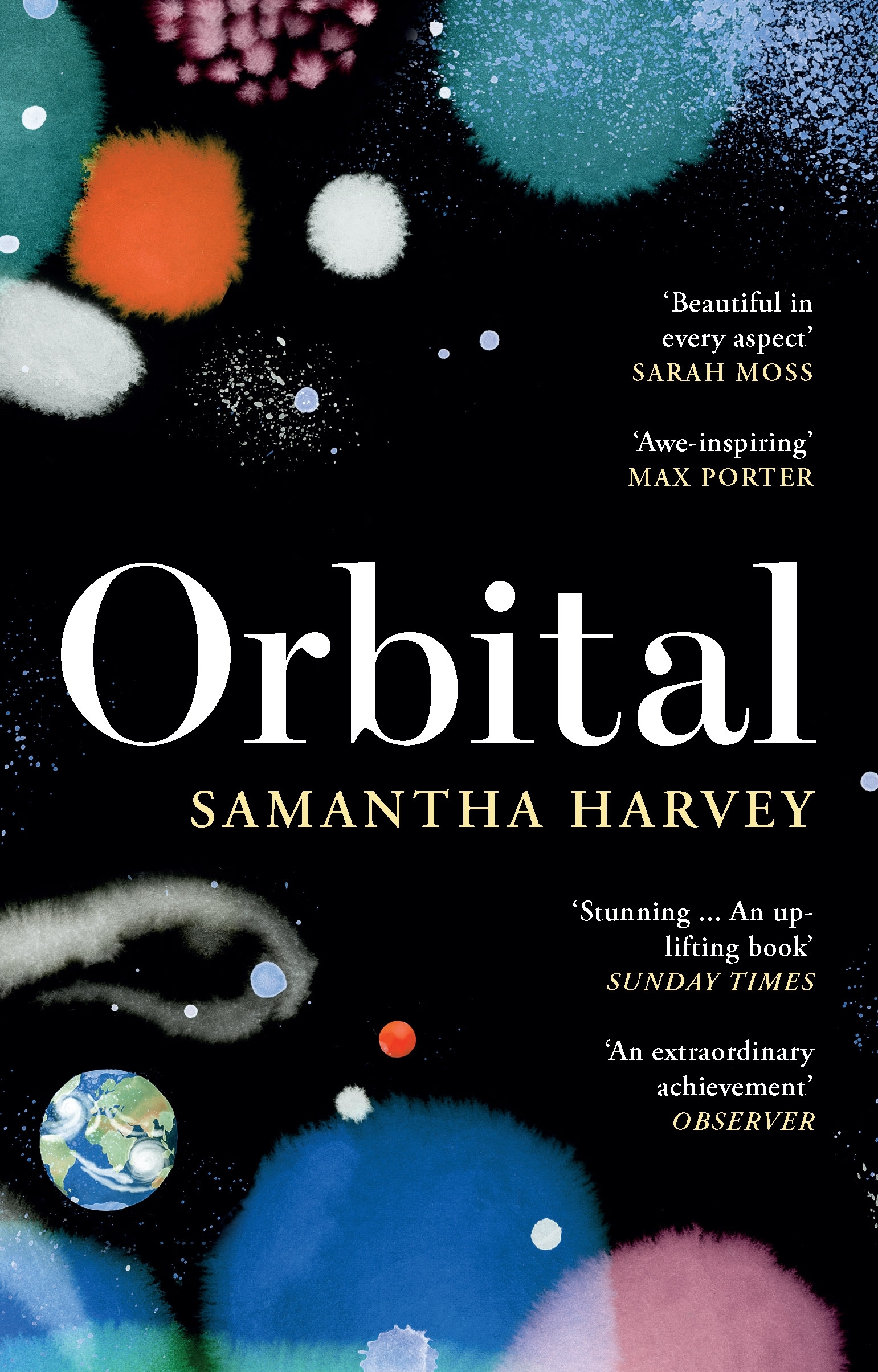
2. Orbital by Samantha Harvey
My second read of the shortlist, Orbital is probably my favorite of the lot. I was reading an ebook and the way I paused and kept writing down my thoughts and excerpts from the book in *this* notebook is no joke. I think half this book is Orbital quotes at this point.

This is about 4 astronauts and 2 cosmonauts up in space orbiting the Earth in one of the space station’s last missions. Through the accounts of these 6 men and women, we see the Earth and the universe beyond in all its vastness and grandeur, provoking thoughts about humanity, how its collective mind is turned inwards, its generosity, its cruelty, human connection, and how, despite us knowing a lot, the extent of our knowledge is still limited in the grand scheme of things.
On an individual level, we are taken through the lives of these people in the station through their thoughts and reminiscences. And all this, in the backdrop of 16 sunrises and sunsets every day, given that they are hurtling in an orbit around the Earth at thousands of miles an hour.
Orbital starts off feeling a little abrupt, what with the lack of punctuation, but it soon grew on me, so much so that a few pages in, I was frantically noting down so many sentences and paragraphs, my hand started aching.
It is atmospheric and transports you into outer space. I know I did, and every time I had to tear myself away from the sight of the Earth twirling away before me and from the weightlessness of space and from the thoughts of me being a speck in the grand scheme of things, was a disappointment of gigantic proportions.
The writing keeps you invested and will hold your hand as it takes you through a slew of existential questions that will keep orbiting your mind as surely as the moon orbits the Earth and the Earth in turn orbits the Sun.
I loved this book so much that when I went to meet a friend who was in Sydney and we bought each other books, Orbital was what I chose for her to get me. It is a book that I will keep close to my heart for a long, long time, and one that I will be rereading very, very soon.
3. Held by Anne Michaels
Oooooh boy this book. This *clap* book *clap*
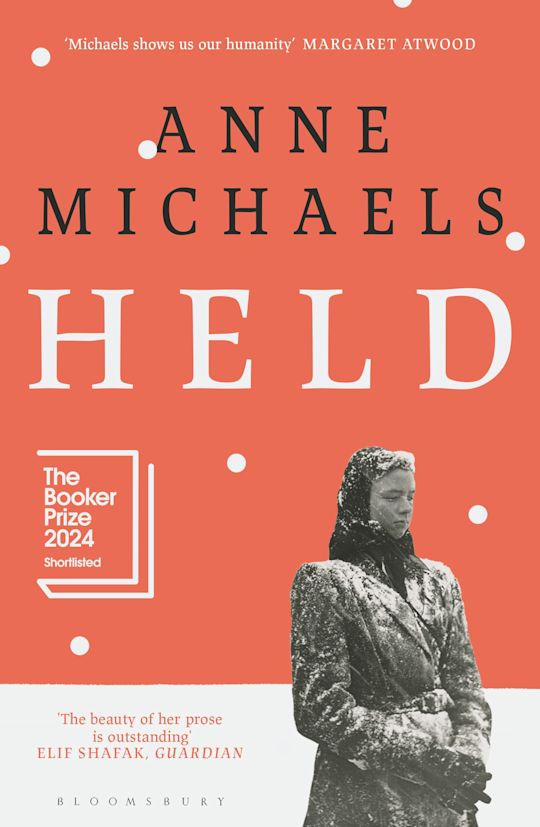
Held is a historical fiction told in bits and pieces. We go back and forth in time, following soldiers, war veterans, nurses, their family members, friends, the power of community, working a business in a polarizing time, and the resonating power of feelings and decisions, something that can be felt generations down the line.
On its own, it feels like a fantastic premise, because around a war – something that feels ongoing for a number of reasons – emotions pulse and examining them against the violent backdrop is important.
But the problem with this book is that it feels like a fragmented, broken narrative trying very hard to be relatable with the “quotable quotes” scattered throughout the story. And that was the least of my problems with this book. There were so many places in there that I was simply bored. The abrupt jumps between narrative points, the contemplative sentences between said points, the disjointedness of it all – it just didn’t work for me.
At the end of the book, I was left with a raging headache – which is never a good thing to have after a book ends.
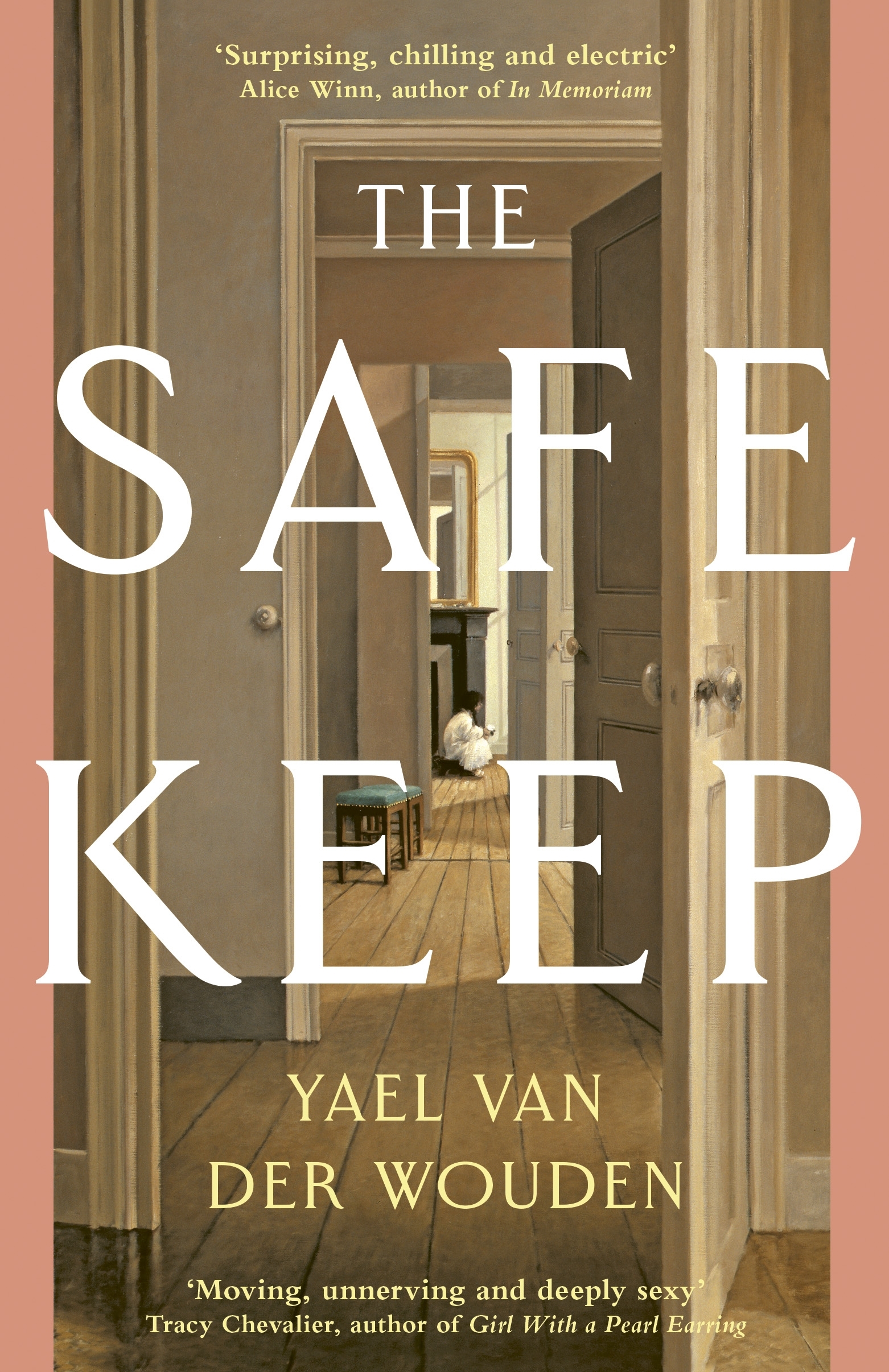
4. The Safekeep by Yael Van Der Wouden
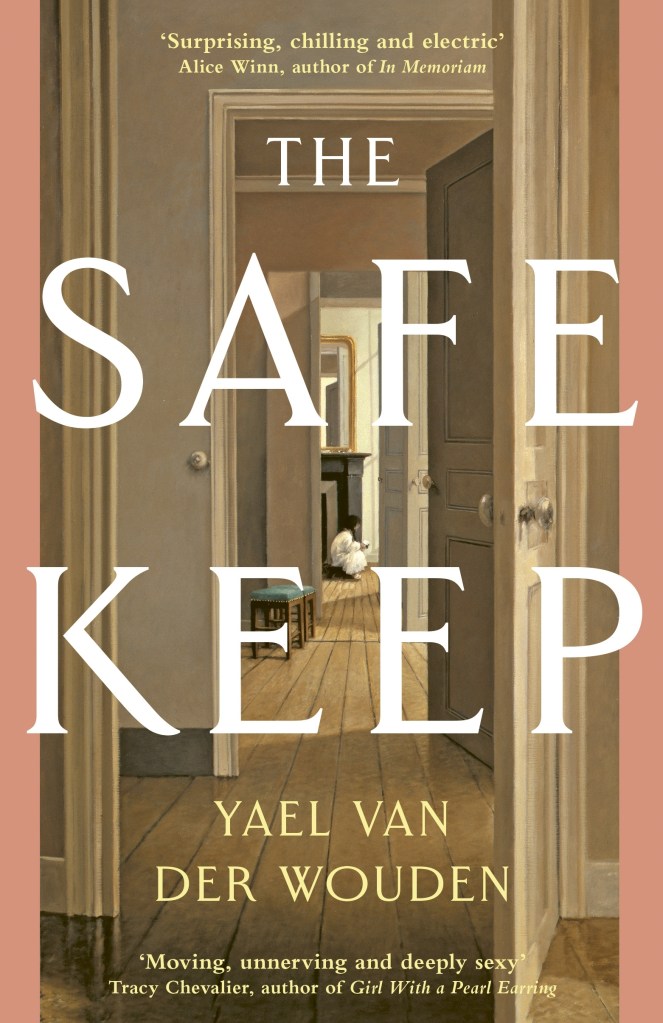
Set in 1961 Netherlands, The Safekeep follows Isabel, a severe, serious woman living in the country home that once belonged to her mother. She is meticulous in recording the contents of the home and is untrusting of people, especially the house help, convinced that the help is stealing from her.
One evening, at a family dinner, her brother Louis introduces them to Eva, his girlfriend. Hendrik, Louis and Isabel’s younger brother, hides his disapproval well, but Isabel is open in her disdain. And when Louis has to go out of town, he leaves Eva at Isabel’s. What follows is a lot of butting of opinions, suspicions of things disappearing, and all of it morphing into an infatuation teetering on the edge of obsession.
But when Isabel discovers something massive and explosive, things are about to change in a way that she never thought was possible, and a war that ended years ago makes its way into the house.
To be honest, the characters make it very difficult to love this book at the beginning. Isabel and Eva are both characters who made me want to tear my hair out. One because she was too strict on the verge of being tyrannical, and rigorous; the other because she was too irreverent and disrespectful of boundaries.
The writing, on the other hand, makes you work hard to like it. At least the first half takes a long stroll around the garden as if there aren’t readers getting sunburn just a few feet from the writing. The second half on the other hand is like a courtroom – every piece of information starts entering the room and stays there for you to paint the picture. And what a picture it is!
So many things that were unseen to the naked eye at first become clear:
- The queer angst of the 1960s
- Loneliness and solitude, but also how they contrast against the misogynistic society of the time
- “Don’t judge a book by its cover”
I also want to point out the irony that shows itself – in this book or through this book, I can’t tell – but Jewish people losing their homes to antisemitism and so much more, and then their hardliners (Zionists) inflicting the exact same racism upon the Arabs will never not astound, exasperate, anger, and disgust me in equal measure! This needs to be studied but I think we already know what that is.
The end to this book, however, felt a little rushed. Like… The speed at which everything was tied up was, I felt, not proportionate to the speed that the rest of the book was going along at.
I’ll still rate this book favorably and highly so, especially and mostly because of how it focuses on how far into the future the effects of war can be felt.
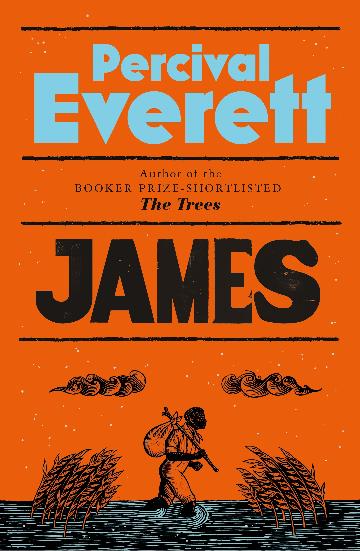
5. James by Percival Everett
All I want to say about James is: WHAT A BOOK!

This is a reimagining of Mark Twain’s Adventures of Huckleberry Finn and is told from Jim’s point of view. Jim is an enslaved man, who, when he learns that he is about to be sold to someone else, runs away and hides on the nearby Jackson island. He is joined by Huckleberry Finn, who after having faked his own death to escape his violent father, is also on the run.
Now they go on a journey together but while seeing the story from Huck’s perspective can make so many important details irrelevant (as happens in a white supremacist society), seeing them through Jim’s perspective opens up so many more avenues, gives us so many more insights into how society worked back then.
Percival Everett brings out the nuances to Jim’s story in a compelling and searing manner that peels layers off your mind and everything you know about society. He examines white supremacy and privilege in a way that is precise and microscopic, what and who upheld it at the time, and shines light on the things that people explained away as being traits of ‘good’ white people but which in fact still enabled the upholders of slavery. More than anything, we see how Black joy and love and intellect was oppressed just so that white people could feel good about themselves.
James is the story of one man on the run, fighting for survival in a world that is hell bent on shackling him and his people.
It is the story of resilience, of determination, of a man caught between a rock and a hard place, but who plows on and does what is right because in the world he lives in, he’s dead either way.
It is the story of a man fighting for freedom, for family, the story of a kind, smart, educated man who knows how to use his traits to survive.
It is the story of one man’s journey from Jim to James, a journey that takes great bravery to do in a world ruled by people who despised people like him.
I love this book to no end and I know that I’m going to be thinking about it for a long time to come. One of my 2024 favorites!
6. Creation Lake by Rachel Kushner

I left Creation Lake for last, I know, I did this to myself. But I tried. I swear I tried. But I couldn’t get into the story any further than before. It irritated me too early into the book to even warrant me explaining the book in my own terms. And considering how quickly I stopped reading, I’m not going to put it on my book list.
I’ll tell you what I’ve told everyone who asked me on Instagram about why I DNFed it: This book feels like it doesn’t know what it wants to be – fiction or nonfiction or a PhD thesis. There were multiple times where my only comments on the prose were: “bombastic side-eyeing this book so bad”.
I might pick it up some time later, just to see what it is. But now is just not that time. And that’s all I can tell you about it.
Now… Moving on to my ranking of these books. I have to say that Creation Lake is not at the bottom of this list even though I DNFed it. Or maybe because I DNFed it.
Here are the books from this shortlist, ranked from worst to best – in my opinion:
6. Held – I don’t see this book at any other position, to be honest. It’s just too much of a broken narrative for my liking.
5. Creation Lake – I did DNF it, so it makes sense that it would sit right next to the book that I didn’t like, right?
4. Stone Yard Devotional – This was a book that I did like, but only to a certain extent. It goes to show how good the shortlist was to me that a book that I objectively liked ended up at 4.
3. The Safekeep – Given that the top two are favorites to the next level, there was only one place for this book – 3.
And now, there was a fierce fight between the next two books, as to which would take which spot. But one just edged the other out in terms of poetic writing. Believe me it was the tiniest difference.
So at 2 was James and the top spot was taken by Orbital, a book that I hold so dear in so many ways that I’ve already described here before. It’s just *chef’s kiss*
As to my prediction, there were three parts to it:
One is that I WANTED Orbital to win, given that it covers such larger concepts such as the minuteness of humanity in the grand scheme of things and the importance of holding onto human emotions and connections through all of this.
Second is that I THOUGHT James will win because it flips a classic and gives us the story of a character who is marginalized in more ways than one, having been used as a plot point to further the story of the main characters but who now has a voice of his own.
Third is who I thought WOULD actually win. I did think that this was James, too, but I also had the sneaking suspicion that Held or Creation Lake might sneak up on James and take the cake.
But my final prediction was that I hoped and I thought that James would win the Booker Prize 2024.
And everything worked out in my favor because the book that I wanted to win, Orbital, actually won the Booker Prize 2024 and I was on Cloud 9. Here’s the Instagram reel that I made, reacting to the winner: Booker Reaction.

So those were my reviews of the Booker Prize 2024 shortlist. What did you think of these reviews? Did you like them? Have you read any of these books? If you have, which was your favorite? If you haven’t, will you pick them up after reading this blog post? Let me know in the comments below. I’d love to hear from you!
If you’d like to watch my Booker Prize 2024 video too, here’s the link: Booker Prize 2024 Review & Ranking.
I’ll see you in the next blog post.
Until next time, keep reading, keep watching, and add melodrama to your life! 🙂
 The Melodramatic Bookworm