

If you’ve been on Book Twitter over the past few weeks, you’ll know that an account called Bigolas Dickolas Wolfwood tweeted about a book called This is How You Lose the Time War. The tweet blew up, so much that there are now cosplays involving people holding up huge mockups of the book. This became, for me, a case of wanting to jump on the bandwagon, especially since I’d seen this book on a few lists by this point and made a mental note to get to it someday. The tweet came as a final push.
I finished this book at 2 AM and every cell of my body was screaming in frustration. It still is as I try to write this review. And if you ask me what the book is about, I’ll probably be able to tell you. In bits, pieces, and fragments, perhaps, like the book itself is, but I can. What I cannot wrap my head around is how the book is written.
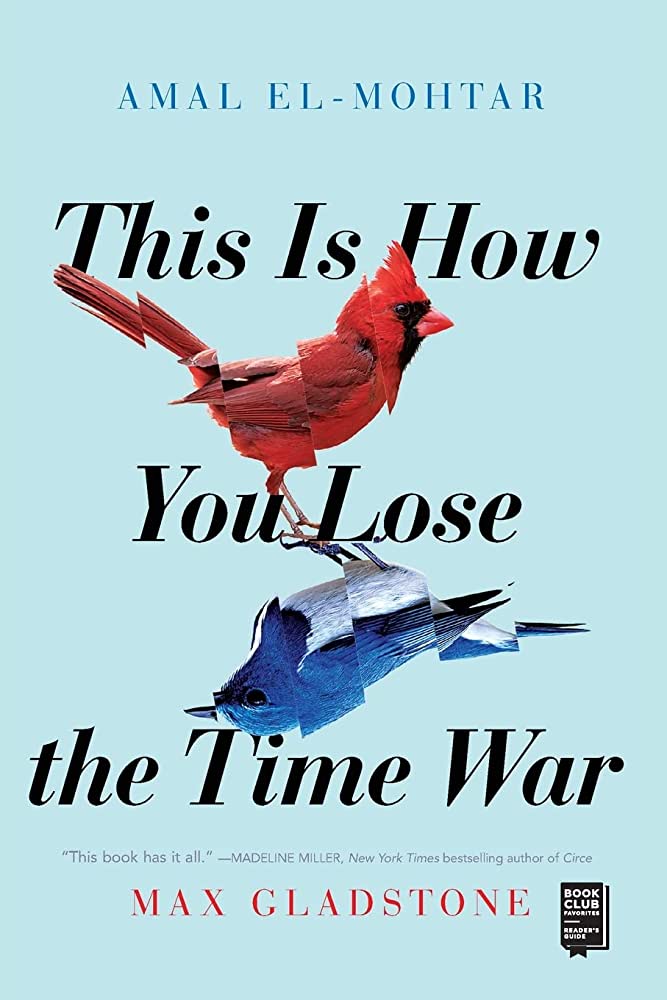
This is How You Lose the Time War is a science-fiction sapphic romance in which two agents from opposing factions(?) are in a war of sorts through time. They travel up and down time, fixing, destroying, erasing things so that time flows as it should. But through it all, through the exchange of letters, they fall for each other. This will obviously have repercussions if their agencies were to find out. But what will Red and Blue do to keep these secrets to themselves? Will they risk everything they have ever known for each other?
Never has a book made me feel so dumb, driven me to tears of frustration, made me wonder what I was missing. Never have I been so miserable and restless and frantic, trying to go over bits of the book over and over again, trying to understand what it is that I’m missing, but ending up frowning in confusion all over again because the book is just that. Never have I felt the pressure of a thousand people’s opinions pressing down on me, making me doubt my own mind. Never have I felt such a gasping annoyance with poetry in prose and the assumption that smudging out more than half the details makes a story more mysteriously beautiful, the pangs of longing putting it beyond reach of criticism.
There’s a self-importance to this book, an undertone that tells the reader to figure things out for themselves. And this, to me, seems like a shadowy combination of two things that I’ve come to learn/observe over my reading life.
One: I read somewhere that the Frankenstein as we know it today isn’t the one that was originally written. Mary Shelley wrote a story in simple, easy-to-read language that would not have pickled the readers’ heads in. It was her husband that took the manuscript and twisted it into the more complex version it now is.
Two: My thoughts about Margaret Atwood’s books have always been on less favorable lines. I am of the opinion that her writing puts the burden of putting the pieces of the story together on the reader’s shoulder, something that I’ve always said and maintain. This brand of storytelling isn’t something I enjoy very much, although I do acknowledge that the concept, the subject it handles is an important one.
While This is How You Lose the Time War has a unique storyline, it is, on the other hand, a book that prompts feelings within me that are eerie reflections of those related to the aforementioned books. It takes a concept and uses the most flowery, purple prose to describe events, which is what obscures the whole point, really. If you’re layering a story under so much weight of the language, rest assured the reader – or at least a reader like me – is going to be more frustrated than spellbound. It is like Margaret Atwood’s writing looping in on itself, double, triple, quadruple layered, and draining my brain from my skull.
I know there are thousands of readers out there who love this book and swear by it. And I respect that. I also respect the authors because this writing does exhibit flair. A rather imposing, opulent one, but the flair is there. And yet, I have to fight to keep my eyes from narrowing. Given, my eyesight isn’t great, but that has nothing to with the fact that I don’t see the appeal of such heavy, exhausting prose.
The ultimate ‘you’ve got to be kidding me’ moment came when one of them says this:
I veer rhapsodic. My prose purples.
And I stared at the page in exasperation, a vein throbbing in my forehead as I screamed silently. What do you mean, ‘purples’? What do you mean by suggesting that it is only just purpling? What have I been reading for the past so many pages? How is it that this prose is so self-aware and yet so blind to its own qualities? How can something be such a paradox?
The thread of the story, its skeleton, is simple enough, only made exhausting and tedious and easy to dismiss by the writing itself. It’s ironic, given that the whole book talks about strands of time and trudging, flying, walking, running through them to find a semblance of peace. I don’t mind when a book makes me work for the story it is telling. But when books start to smudge the details, omit them when they’re needed the most, and then make me work to fill in the blanks, that’s where I draw the line.
I am exhausted and have a headache now, my body screaming, my energy drained, because of two people traveling through time to etch a strange love into the annals of the past, present, and future. And yet, my brain cannot stop going over these strands, causing minor earthquakes in my mind, triggering it to no end. I am, like the book itself, a paradox – exhausted but pumped with anger; brain in overdrive but struggling with a pounding headache; energy drained but energy gained to rail against the book.
And yet… To what end? Because isn’t life a time war in itself? We lose the time war with each passing minute. We were never meant to win. So when Amal El-Mohtar and Max Gladstone wrote This is How You Lose the Time War, they were just warning me against myself, against the paradoxical cannonball of anger, annoyance, irritation, understanding, and relatability that I’ve become.
End note: If you haven’t read this book yet and are contemplating picking it up, I will not dissuade you from reading this book. But I will say this: Be prepared for a long 198 pages. Be prepared for layers and layers of purple prose that has a higher chance of frustrating and irritating a person than not. And don’t you dare go in with a mountain of expectations. Keep it cool, keep it simple.
Have you read This is How You Lose the Time War? If you have, what did you think of it? If you haven’t…I’ll leave it at that. Let me know in the comments below. I’d love to hear from you!
I’ll see you in the next blog post.
Until next time, keep reading, and add melodrama to your life!


I had a very different experience but I can see what you mean. All I can say is I hope you soon forget the book and the frustrations 😅
LikeLiked by 1 person
Oh I see why you loved it! Seriously. It just got me riled up, is all 😂 Thanks, Sumedha 😍
LikeLike
I finished around 5 chapters and still couldn’t understand why I found the book not that appealing. thought I’m simply dumb. but this review helped. 😭
LikeLiked by 1 person
Glad to hear that! 😊 Also, knowing that I’m not alone in my opinion about this book makes my day! Thanks for commenting 😊
LikeLike
I love your review! I identify with so much of what you wrote.
I also love the book…so here’s to you for sharing so eloquently what it is that was a stumbling block.
LikeLiked by 1 person
Thank you so much for the kind words despite having a wholly different experience with the book 🥹
It’s refreshing and means a lot to me!
LikeLike