

Roman Stories is Jhumpa Lahiri’s latest work, a return to her roots, if you will, because this is a collection of short stories like her Pulitzer Prize winning Interpreter of Maladies. I’ve been a fan of Jhumpa Lahiri’s writing for a bit and when this book was announced, I promptly lost my mind. But before I get into what I think of her new book, I have to take a step or two back to tell you how I fell in love with her words.
My love for Jhumpa Lahiri exploded within me in 2022. That was the time that I had just gotten through a rough patch and was learning a new language. Reading about Lahiri’s experiences with language and her observations of it gave me a sense of validation like never before. I had read 3 of her previous works by then – The Clothing of Books, which I really liked; The Namesake, which I was neutral about but was leaning towards the positive side on; Whereabouts, which I absolutely loved. But do you know that feeling when you love one book by an author and you pray that the next book you read by them will be as hard-hitting as the previous one and when it is, your love pours out of you in a massive volcano eruption of relief and admiration? Yeah, that. That happened with In Other Words and my gaze towards her and all her other works softened. My love for her writing made itself known with such clarity that I was left speechless, powerless in the presence of her words.
So you can imagine my reaction to the publication of Roman Stories. It was not just the fact that it was Jhumpa Lahiri writing that made me so excited. I was also utterly taken with the idea of Lahiri, an assimilated Italian, writing a collection of stories that centered people in Rome who feel that pang of unbelonging because other people just won’t let it go.
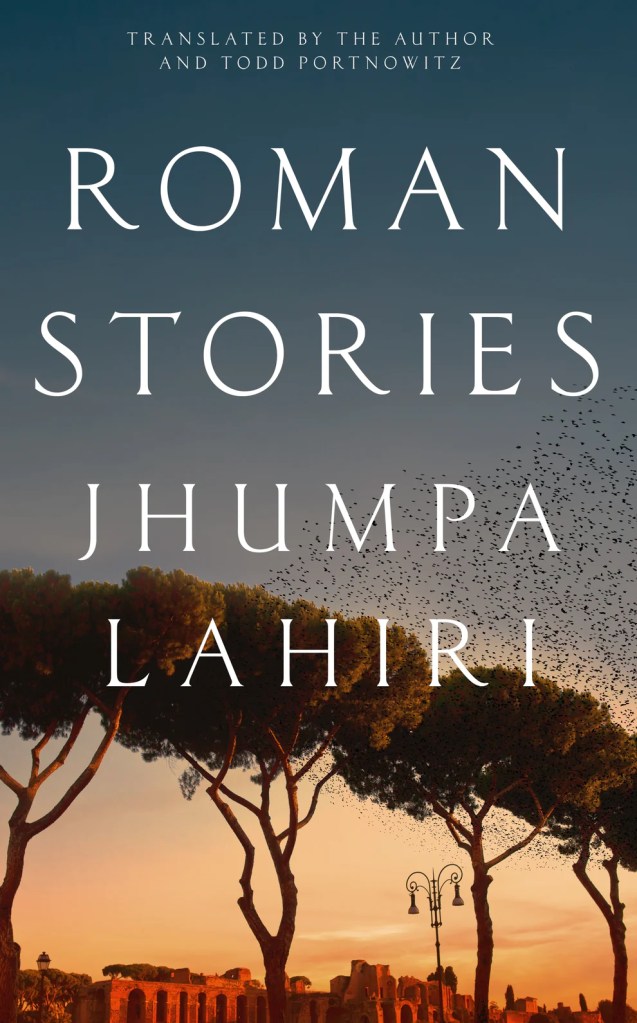
Roman Stories has Jhumpa Lahiri’s trademark vagueness, the not naming of characters which, ironically, make them more relatable. She writes of feelings that could be universal or specific, depending on how you see it. But whichever way you see it, you’ll find yourself lingering at the foot of those steps, at a piazza waiting for the Procession to pass by, by the sea, in a cafe drinking coffee and eating panettone, over Italian words that you don’t have any idea what they mean – she’s stark and vague in her writing, all wrapped up in the most beautiful of words, using metaphors one would never think to use, those that seem to only make themselves available to Jhumpa Lahiri.
The title, as I see it, is an ode to the Rome of old but also makes the Rome that Lahiri sets her stories in as something of an all-encompassing constant existence that has been here for millennia and will be there for millennia to come. She turns these stories into individual biographies and autobiographies, with each character showing us the mirror in one way or another, each of them reflecting back our own inadequacies, our own dilemmas, the battles that we fight with ourselves to be able to express ourselves better. And like with so many of our thoughts, there are some stories we’ll like, some we won’t, and some we’ll detest from the bottom of our hearts.
In writing these Roman Stories, Lahiri talks of immigrant life, conditioned hate and xenophobia, finding community, starting over, the things we do for family – oh, these stories are a veritable mine! The more you go looking, the more you’ll find. Or not. They’ll come find you anyway. But with them, you’ll get a finger on the pulse, the essence of what Lahiri is trying to do. Italy is a character in these stories and the more you read, the more you want to move there, and the more you’re glad you aren’t there. Lahiri’s writing is nothing if not paradoxical in its own way.
That said, while these stories hold on to their loveliness and the political points that she makes without saying them outright, there’s something missing in them. Is it because they were first written in Italian and then translated into English? I wouldn’t go as far as saying that the David that is lost-in-translation has finally felled the Goliath that is Jhumpa Lahiri, because this Goliath isn’t one that can be felled. But there’s a quick, noticeable stumble for sure.
Roman Stories started off wonderfully for me, but the middle flagged – and noticeably so – before picking up in the last couple of stories. And for that recovery, I will forever be glad.
If you’re looking to start Jhumpa Lahiri’s works, I wouldn’t recommend this to be your first. Read her older works instead, like Interpreter of Maladies for fiction short stories and In Other Words for nonfiction. But once you have dipped your toes in her bibliography, yes, do come back and give this a try.
Related: My review of this book on Instagram is here.
So that was my little review of one of my favorite authors, Jhumpa Lahiri’s latest offering, Roman Stories.
Have you read any of her books before? If yes, did you find a favorite? Have you read Roman Stories? If yes, did you like it? If no, will you pick it up after reading my review? Let me know in the comments below. I’d love to hear from you!
I’ll see you in the next blog post.
Until next time, keep reading, and add melodrama to your life! ❤
 The Melodramatic Bookworm
After reading your review of this book by Jhumpa Lahiri I felt my brain got drilled and thought that I should read her book.
LikeLiked by 1 person