
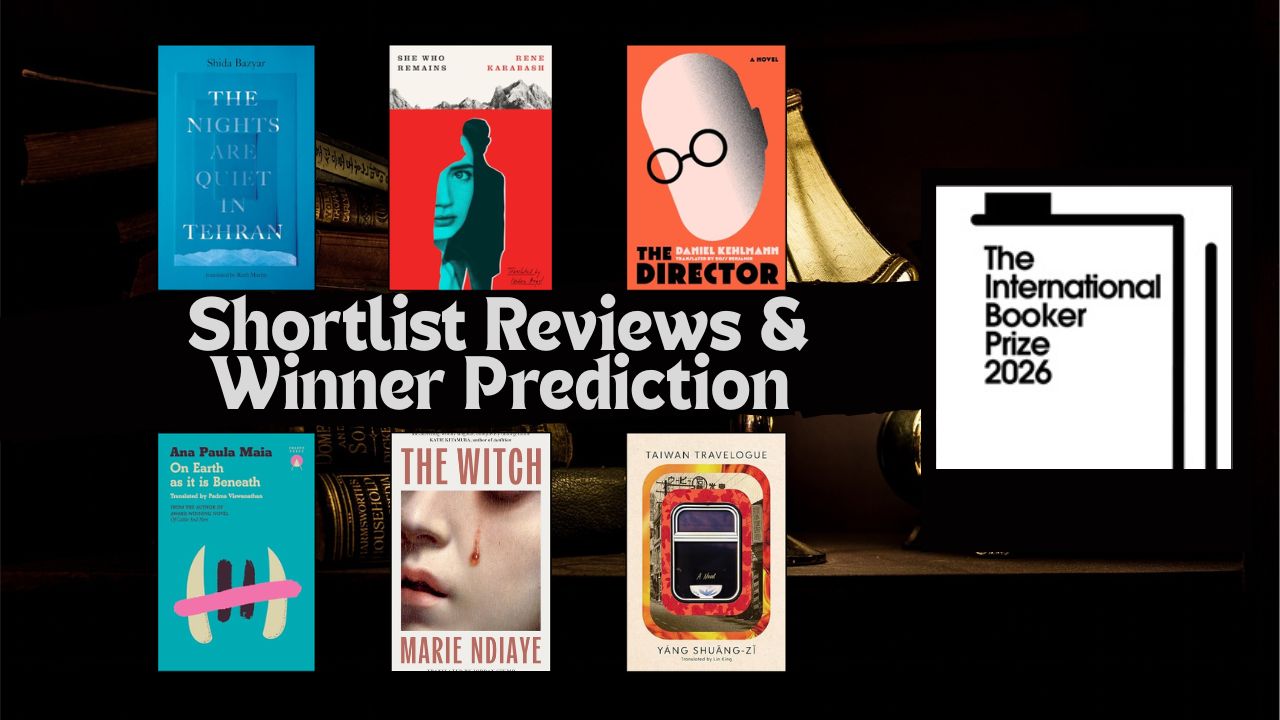
It’s International Booker Prize time and I’m back with my shortlist reviews and winner prediction for 2026. Buckle in because there are some really strong translations and stories on this shortlist! The winner will be announced on May 19th, in exactly a week, and the reviews and prediction have gone up on YouTube & Instagram.
I posted the comprehensive YouTube video a couple of days ago. If you’d like to go watch that instead, here’s the link: International Booker Prize 2026 Winner Prediction Video.
As always there are 6 translated books that have been shortlisted, each with a different setting or a different theme that it explores. But all of these books have one thing in common: they are stories steeped in moral dilemmas and world history that will keep you invested and ruminating long after you turn the last page. Some might not immediately click with you and you might not even like the writing style. But what they’re trying to say will definitely get through, even if it takes some time to do so.
The six books that have been shortlisted for the International Booker Prize 2024 are:
Now before we move on to who I think will win the International Booker Prize 2026, let me take you through what these books are about and my reviews of the books. These will be in chronological order of my reading them and I’ll try to keep them as short as possible.
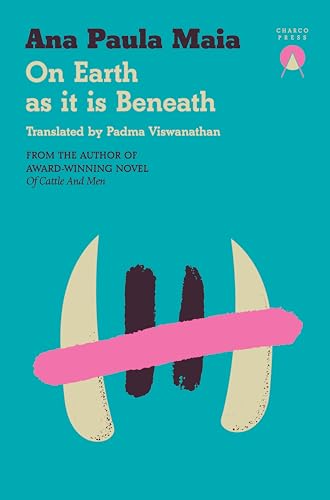
On Earth As It Is Beneath by Ana Paula Maia, translated from the Portuguese by Padma Viswanathan
Goodreads classifies this as horror fiction but I think it is more of a literary meets psychological fiction, because it explores the human psyche and raises questions about it through the actions of these characters.
The story is set in a penal colony in the wilderness. Prisoners are brought here for rehabilitation but all this so-called institution does is trap them. Now, decades later, they’re shutting this colony down and the warden has started a game where the prisoners are released on full moon nights and the guards hunt them down with rifles. The question is not whether the prisoners will escape. It is how they will meet their end. And who is more dangerous — the convicted, or the warden who takes justice into his own hands?
On Earth As It Is Beneath is the unsettling story of man’s capability for violence. It is about how we tend to only look at the present and decide who the victims and perpetrators are. If you are active online, you’ll see a lot of examples for this, without discussion and without nuance. That’s probably why we are at the point we are right now.
Coming back to the book, I think what this book was trying to say was that the frame of reference changes depending on what we’re being told. The point still stands about history and context, but this book does a good job of making you reevaluate things from page to page to page.
As the Colony descends into a violent madness because of Melquiades, the text forces us to consider where we stand and who we’re rooting for, while understanding that humans, no matter how much we evolve, we’ll always have a violent streak to us, be it out of self-preservation or out of a self-righteous call for justice.
I can’t say I enjoyed the story because of how bleak and violent it is. But I did enjoy putting my grey cells to use to navigate the morality and reflective reality of it all.
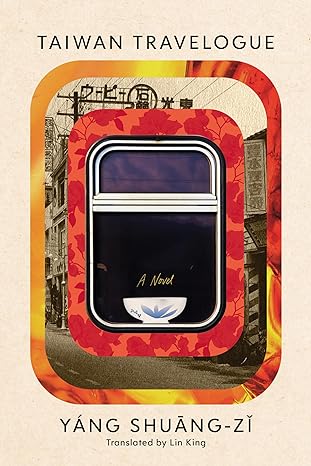
Taiwan Travelogue by Yáng Shuāng-zǐ, translated from the Mandarin Chinese by Lin King
Earlier this year, I read a book that got me thinking—are common people in colonizer countries truly ignorant in that they don’t know what’s going on or do they buy into what their governments tell them? I came face to face with this question again in Taiwan Travelogue.
Taiwan Travelogue is a travelogue, but completely fictional. It is modeled as a rediscovered text by a fictional travel writer in the late 1930s. Chizuko travels from Japan to experience island life and food in Taiwan. She is helped by a Taiwanese interpreter, Chizuru, and they build up a friendship that has multiple layers to it, many of which Chizuko doesn’t see.
It is a discourse on how common people from colonizer countries cannot see the problem with many of their normalized behaviours. It is the story of food, colonialism, and colonial blindness in a way that will grow on you throughout the book. At first, it wins you over and pulls you in with food. But then in one shot, it turns a corner and boom! You’ve been reading a much bigger story, pieces of which have been scattered throughout the story in plain sight.
When you start the book, Chizuko seems like a perfect visitor to the Island of Taiwan. She is respectful of the food, the people, and especially of her interpreter, Chi-chan. Writer and interpreter seem to build a friendship through the book and it starts giving you ideas about their relationship. But it’s also that the author is telling you only as much as she wants you to know until she’s ready to reveal more, just like Chi-chan, the interpreter is.
The writing is fresh and earnest, but it is also enigmatic, making you wonder what else you have missed once you unravel that first layer. And while it teaches you SO much about Taiwan, the food destination (for lack of a better term), more than that, it helps you learn about the Island’s colonial history. It is more nuanced than “Japan ruled Taiwan” because the micro aggressions that we see in the book are way too prevalent and people are way too comfortable using them without stopping to think about what they might actually mean.
This is a fantastic book, one that deserves to win the International Booker Prize 2026 and one that I’ll probably get a physical copy of and reread soon. Highly recommend! Fabulous, fabulous writing!
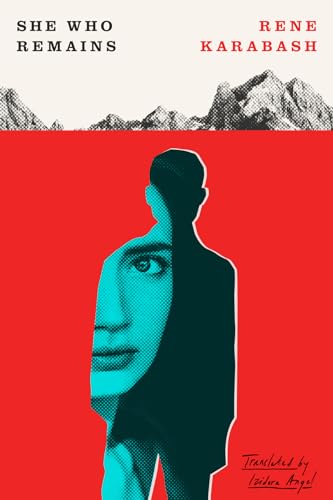
She Who Remains by Rene Karabash, translated from the Bulgarian by Izidora Angel
The sworn virgins of the Balkans are people who are assigned female at birth but take a vow of chastity and live as men, taking on male roles as dictated by the patriarchy. She Who Remains centers one of these sworn virgins.
This is set in the Accursed Mountains and follows Bekija, who is about to be married off. She takes the decision to become a sworn virgin, something that sentences her family to ruin. Now, years later, Bekija, now Matija, talks to a journalist and tells all, with the truth taking on a heavier note, making them realise the weight of all that they have lost.
I really liked what this book was conveying, about the harm of “traditions” that take a woman’s life for granted, about society’s instinctive hatred for queer people and girl children, gentle love, betrayals, actions that emerge from desperation, and so much more.
There are so many points in the story where events are repeated but each time, you get to see it from a slightly different perspective. I usually get irritated by repetitions and I did here too, but that was until I realised what the author was doing. The writing style adapts itself to the character and we can tell which character is talking/writing by when the stream-of-consciousness appears and disappears.
But whatever you feel about this book at any given point in it, there’s still a weight on your chest as you read it, as if you intuitively know what exactly it is trying to convey. And that weight on your chest soon shifts and morphs into a simmering anger at the world and for the MC. And if a book can make you feel that, it will stay with you for a long time.
Having said that, I felt wildly differently about how all these things were conveyed because it felt a little contrived at times. The language went from being incredibly poetic to forcing the prose into poetic form that it didn’t belong in. I just wish it was a bit more accessible to read but overall, it did cause my stomach to drop and made me want to cry, so that’s always a win.
Did I love it? No.
Did I like it? Yes.
Will I recommend it? Also yes!
Go pick it up. It’s an important one.
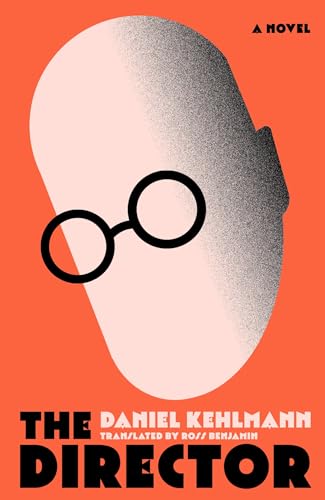
The Director by Daniel Kehlmann, translated from the German by Ross Benjamin
GW Pabst was a Austrian film director and screenwriter who was considered an icon of his time. When World War II broke out, he was forced back to Nazi Germany to make movies. The Director is a fictionalized version of his life.
This book isn’t told in a single file. We see different perspectives—his and the people around him—and through these, we see Pabst’s life and what he had built for himself. From him trying to make a life in the United States to going back to Austria for his mother to being forced back to Nazi Germany by the Nazis, Kehlmann does an amazing job of giving us a glimpse into Pabst’s mind.
The book is deep and incisive, a fictional expose on a man that held his art in high regard and rejected dictatorship, only to take one decision after another to end up serving that very dictatorship. It is a layered story which begs the question—How is there ANY excuse for participating in a dictatorial, genocidal regime?
The problem is that being forced to do something doesn’t mean you’re fully complicit but also, complicity isn’t erased because you were forced into doing something. That’s the moral dilemma that The Director forces you confront.
Yet another layer describes Nazi surveillance, its omnipresence in 1930s and 1940s Germany, and how so many common people were complicit in everyday antisemitism, crime, and violence.
The writing is brilliant in the way it shows the ebbs and flows not only in Pabst’s character, but also in the people around him. Through these descriptions, Kehlmann and subsequently Benjamin, show the moral rot that simmers deep in the not-so-‘mysterious depths’ of Pabst as a main character. They use filmmaking terms and techniques to transport you to the scene, which then fills you with an anxiety that you can attribute to Pabst and Wilzek’s actions and fears themselves.
It keeps you on your toes, keeps you thinking, and forces you to confront what you think is right and wrong while throwing up different pieces of information from time to time. The more I think about it, the more I am blown away.
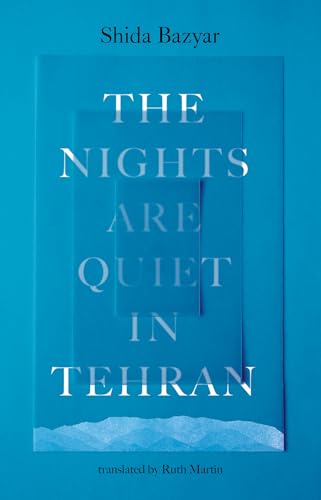
The Nights Are Quiet in Tehran by Shida Bazyar, translated from the German by Ruth Martin
The Iranian Revolution of 1979 overthrew the Pahlavi dynasty in favour of an Islamic Republic. But did the revolution end there? The Nights Are Quiet in Tehran asks this question while taking you through the definition of revolution as seen by different generations.
This book starts off in 1979 Iran with Behzad’s revolutionary days, moves on 10 years into the future with Nahid’s narration of migrant life in Germany, shifts to 1999 where we follow 14-year-old Laleh as she observes Iran and its people, and then another 10-year leap where Mo tells us what he sees: a wholly different but an exactly similar face of the revolution. Common among all of these threads is that battle between belief and their need for freedom.
This book has two separate experiences that it offers the reader. One is while reading the book, where the writing can take you out of the story because of how jarring and stream-of-consciousness-like it is. Second is the story itself that stays with you after you turn the last page, because this is the story of a revolution, of one that doesn’t end when a generation grows up. It’s cyclical, and shows us how the way people think and fight might change, but the fight itself is constant.
The Nights Are Quiet in Tehran is a story that has you wishing that the writing itself was different while you’re reading it but once you’re done and you look back, multiple threads unravel in your mind. Be it what it means to be part of a revolution, or how different people look at different situations, or how immigrant life (especially if you come from a country that’s constantly undergoing a revolution) is so full of people expecting you to have an opinion on everything, or what it means to live what feels like two lives—one in your adopted country and one in the country your parents and ancestors are from.
I won’t say I love this book, because there are many elements, mostly writing-wise, that I didn’t like or took me out of the story without any visible character arcs/development. But I do see the impact that this book is capable of leaving on a reader’s psyche and I see why it’s been shortlisted for the International Booker Prize 2026. And because of all that, I will recommend it.
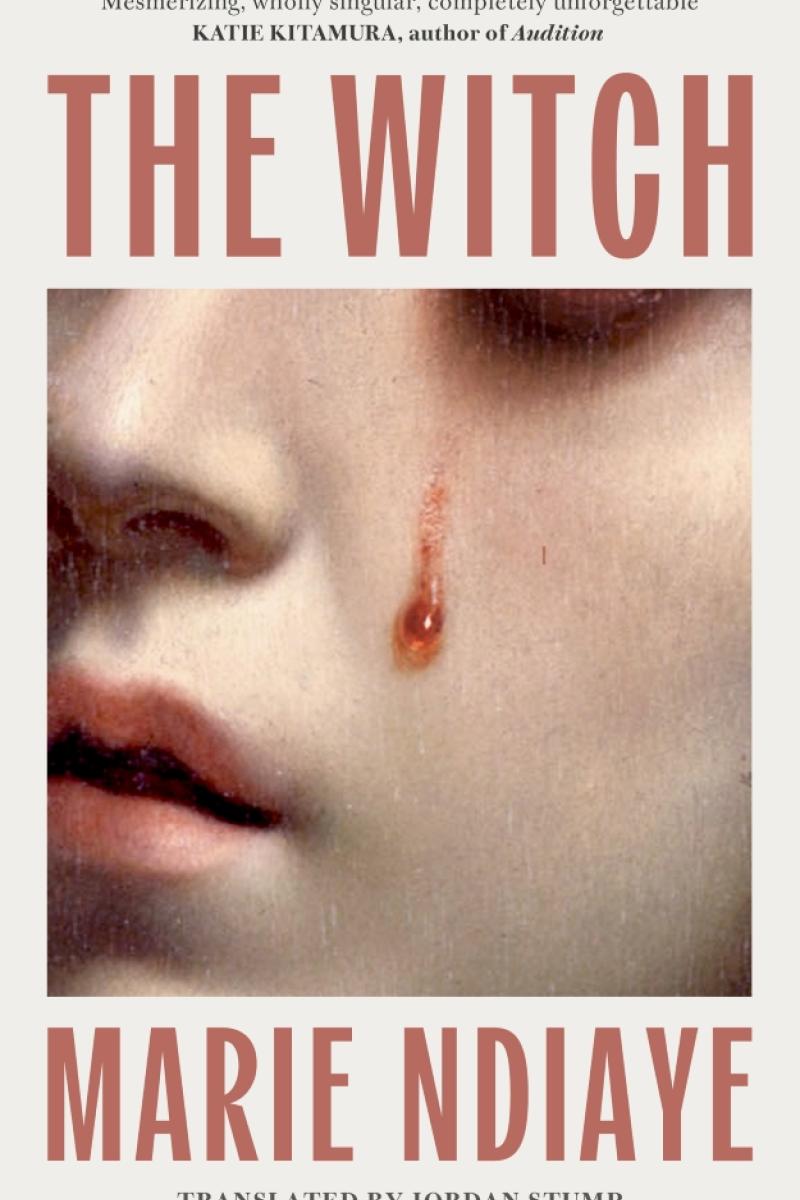
The Witch by Marie Ndiaye, translated from the French by Jordan Stump
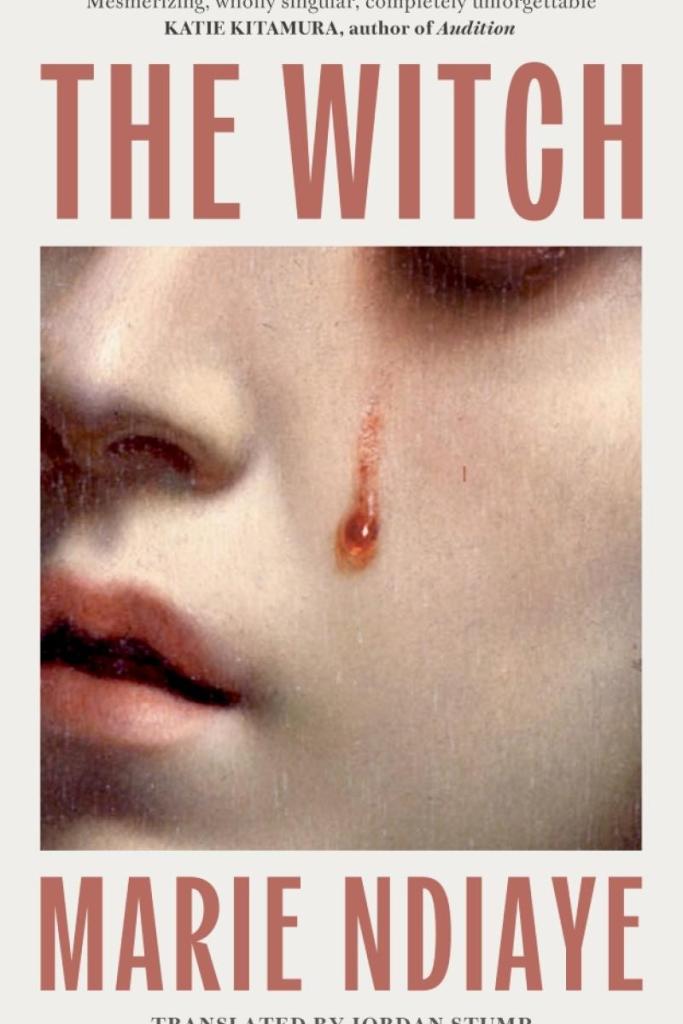
If you like stories with witches that explore womanhood and generational trauma, then The Witch is one that you can pick up.
This is about a woman who is a generational witch and is teaching her daughters about witchery far from the eyes of her husband. Then one day he leaves them and she goes to Paris to bring her divorced parents together. She considers herself to be mediocre and throughout the book, we see her trying to come to terms with that fact.
It probably tries to say something about how sometimes, trying to get to a certain level of perfection can only lead to sorrow while being average can guarantee you happiness. But the writing doesn’t do it any favours. Not to forget, it has a lot and I mean A LOT of fat shaming that exists just for the heck of it and doesn’t prove any point or add any nuance whatsoever, although I don’t see how any type of fat phobia and nuance can be connected.
Coming to the characters — every single one of them is unlikeable, which is fine, but then again, what they’re trying to do and what the plot is trying to prove is unclear. I truly believe that being unlikeable makes a story more interesting because it kind of makes you think of—how do I put it—morality radar? Of what’s acceptable behaviour, cause, effect, and karma? But the characters in this book do things that eventually seem unimportant. Maybe that’s one of the points it’s trying to make but because the prose acts like Pierrot (a grifter in his own sense), it kind of doesn’t arrive at any point at all.
On the positive side, it does explore inherited trauma, womanhood, motherhood, self-esteem issues, and a feeling of an impending event that never quite comes to be, probably a reflection of what life is like.
But overall, the book falls flat and doesn’t manage to keep your attention. It tries to blow up a lot of the events but in the same breath minimises them by dismissing the feelings arising from them. So it doesn’t quite know what to do in the grand scheme of things.
I was really excited to read this book but now that I have, I must say, this is a major, major disappointment. 
WINNER PREDICTION
Now, I’m going to try and predict the winner of International Booker Prize 2026 through a process of elimination even though I know which book I WANT to win it. Even so, I feel like there is a bit of a fight for the top between 2 books. But let me arrive there slowly and step-by-step.
Of the six books, there is one that I’m about 95% sure will not get anywhere near that podium, which is The Witch. Yes, it is my least favourite of the lot, and I genuinely think it’s too vague to make a point strong enough to win. And that’s why I’m kicking it off the list right from the get go.
Of the remaining 5, all of them have weight to them. The question is: which of these pulled their weight and portrayed the point they were making with great writing AND great storytelling?
So next, I’m going to take On Earth As It Is Beneath off the list, as much as I like this book. But I think that in the grand scheme of this shortlist, the way it explores the themes of morality, violence, rage, and the like, ranks a little bit lower on the scale than how the other books explore their themes of the patriarchy, revolution, colonialism, and fascism.
Next I’m going to eliminate She Who Remains. This is an incredibly difficult decision and I did this just because of the writing style. The book itself portrays how patriarchy sees girls and women as expendable and I learned so much about the sworn virgins in the Balkans. But the writing style itself could have been so much better and that’s why this book has to go. Sorry Rene and Izidora.
Next to leave is The Nights Are Quiet in Tehran, a book about revolution and its constancy. With a premise like that, especially as a mirror to whatever is going on in Iran right now, this book could have won. But again, the writing style pulls it back a little and out of my contention for winner this year.
The ultimate battle for me, is between The Director and Taiwan Travelogue, both of these are written in such vastly different styles but have an almost equal impact on the brain.
While The Directoris set during World War II and explores the life of a real historical figure living through the Nazi regime in a fictional format, Taiwan Travelogue is about a fictional travel writer from Japan who feels so very real as we read about her travels in Taiwan. I wouldn’t mind either of these books winning because both are exquisite pieces of literature, both exposing different layers of society and of how humans look at society.
But the thing is… Taiwan Travelogue has a slight upper hand because of how it explores its themes and because of which it hits you that much harder. A sucker punch comprised of colonialism, human emotions and assumptions, and history. And that is exactly why I think Taiwan Travelogue will win the International Booker Prize 2026.
To be fair, there’s a small part of me that thinks The Director will win. And I’ll be happy if that happens too. But because I so desperately want Taiwan Travelogue to win, I’m going to go ahead and lock it in as my winner prediction for the International Booker Prize 2026.
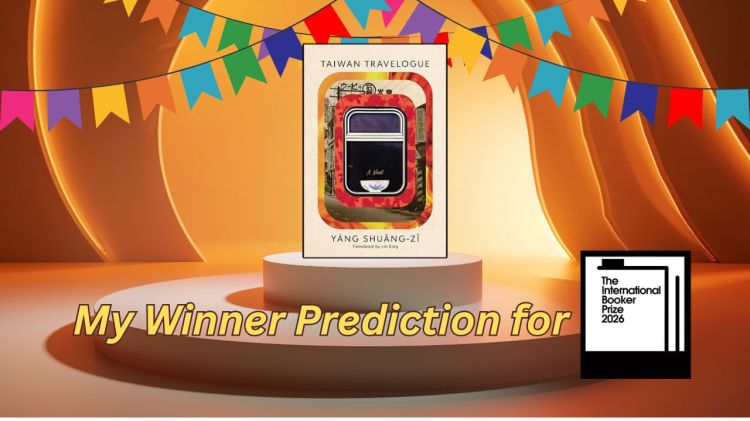
We still have a week before the winner is announced and I, like so many other people, am waiting with bated breath for it, hoping against hope that Taiwan Travelogue wins.
Meanwhile, I just wanted to say that I’m so glad that I read these books. These are books that the Booker Prizes brings to my attention and I’m so grateful to be able to read them and experience these worlds and widen my worldview. I will hopefully do this again for the Booker Prize shortlist in September because at this point, it’s a Melodramatic Bookworm tradition.
But those were my reviews for the International Booker Prize 2026 shortlist and my winner prediction for it as well. The winner will be announced on May 19th in London and I cannot wait to find out that Taiwan Travelogue has won. 😉
So, what did you think of my winner prediction? Do you agree? Have you read any of these books? If you have, which was your favourite? If you haven’t, will you pick them up after reading this post? What book are you rooting for? Let me know in the comments below. I’d love to hear from you!
I hope to see you in the next blog post.
Until next time, keep reading and take care. 🙂

